


The name “Business as Usual” started as a small act of rebellion in a badly designed meeting.
Picture an entire office dragged into a single daily standup because someone heard that “scrum teams do standups.” Not a team standup. An office standup. Sales. Design. Product. Engineering. Marketing. Customer success. People working on different clients, different projects, different priorities, all standing in a circle pretending this was agility.
One senior executive, outside my org but higher on the ladder, was convinced this was the way. He wanted everyone together so he could hear “what’s going on.” It looked like ceremony, so it must be good, right?
I didn’t see a high-functioning company. I saw a cargo cult.
I’ve spent most of my career in places where quality, risk, and regulation matter. You don’t get to hide behind trendy frameworks there. Practices like standups, XP, and agile only make sense when they are in service of a team trying to deliver real value to real customers under real constraints. When you rip them out of context and turn them into mandatory theater, you get the worst version of both worlds: loss of autonomy and no real gain in coordination.
At that company, people used to joke that I was the “walking culture deck.” I was proud of that. Not because I loved slogans, but because I actually believed in the values we had written on the walls. One of them was “Brave”: do the right thing, not the easy thing.
So I did the annoying but necessary thing: I pushed back.
I argued that teams should decide how they work. I walked through the basics of XP and agile: daily communication inside a team that shares a backlog and a goal, tight feedback cycles, clear ownership. I pointed out the obvious: a salesperson working a long-cycle deal and an engineer debugging a production issue don’t benefit from sharing status in the same three-minute window every morning. It just burns time and attention.
The teams agreed. Roughly 80% of the people in that room backed the idea of rethinking or killing the mega-standup. The remaining 20% had other incentives: being seen by the senior executive, staying close to power, signaling loyalty.
I didn’t win.
Hierarchy won. The all-hands standup stayed. Every morning, everyone stood in that circle and went through the motions.
So I found my own way to stay sane.
During my turn in that meeting, I would share whatever was genuinely useful for others – key risks, big deliveries, blockers that needed help. And at the end, I started closing with the same line:
“Other than that… business as usual.”
It began as a dry joke. A way of saying: “There’s nothing here that justifies all of us being in this room, but I’ll respect the decision and keep doing my real job.”
After a couple of weeks, the executive started skipping straight to the punchline. He’d look at me and say, “Business as usual, right?” If I said “Yes, business as usual,” he would move on without an update.
In that tiny interaction, the phrase flipped meaning for me.
On the surface, “business as usual” sounded like compliance. Underneath, it became shorthand for: “I’ll keep doing the real work of serving customers and supporting teams, no matter how much ceremony you throw at me.”
From there, it took on a life of its own.
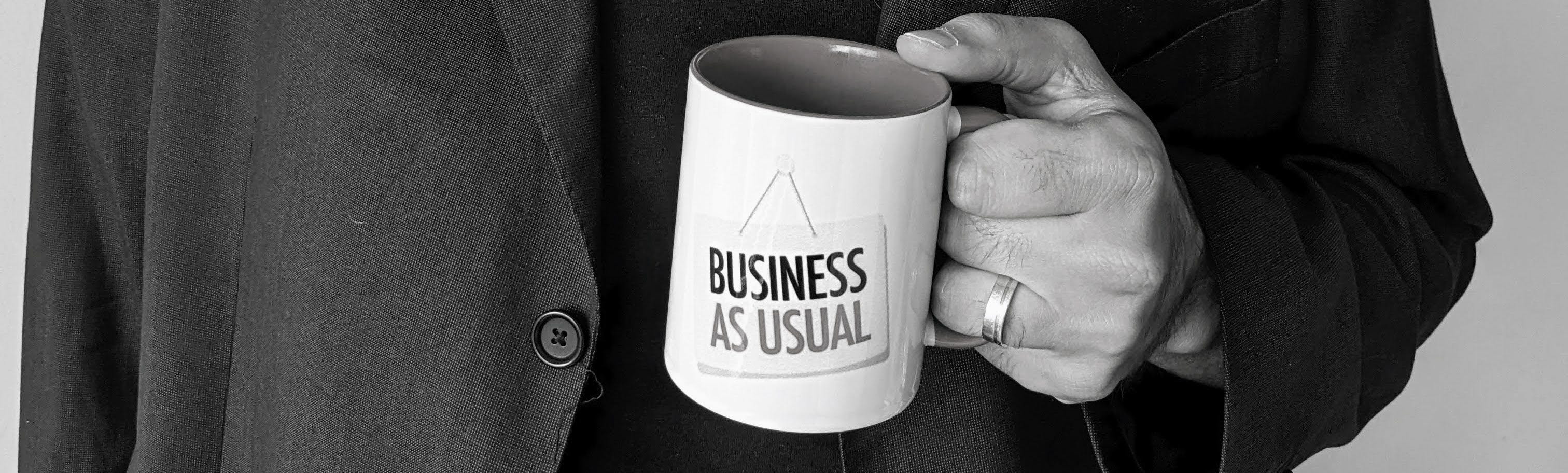
The team gave me a mug with “Business as Usual” on it. It wasn’t just a gag gift. It was a quiet alignment: “We see what you’re doing. We know the difference between rituals that help us and rituals that exist so someone can feel in control.”
On my last day at that company, I walked into the office and froze.
Everyone was wearing a hoodie with my face on it and “Business as Usual” as the caption. Not a sticker someone printed at home. Actual official swag, approved and produced by the company.
I still think about that moment. Not because my face was on a hoodie – that part is ridiculous. What mattered was that a simple phrase had turned into a shared story: a group of people choosing to care more about outcomes than theater, and having fun with it instead of turning bitter.

Years later, when I decided to start a blog, that story came back immediately.
I didn’t want a name that sounded like a consulting firm or a tech newsletter. I wanted something that captured a tension I see in almost every company: the gap between what we say we value and the way we actually work day to day.
“Business as Usual” was perfect because it’s a trap phrase.
Most organizations have a silent list of things that fall under “business as usual”:
Daily meetings that no one questions anymore. Quarterly planning done the same way it was five years ago, even though the market has shifted. Status reports that exist mainly so someone three levels up feels informed. Frameworks adopted by name while the actual practices are broken beyond recognition.
When people say “That’s just how we do it here,” that’s the moment my brain wakes up. Why? Who does this help? What problem was this trying to solve, and is that problem still the same?
The blog exists to poke at those habits.
Not from a place of cynicism, but from the same value that pushed me to challenge that standup: be brave enough to do the right thing, even when it cuts across habit, hierarchy, or trend.
I don’t have anything against standups. I like them when they belong to a team, when they’re born from a shared need for visibility and coordination, when they’re part of clear team norms. The “how” is always a design choice. If a Kanban board works better than a spoken standup, use that. If an async update in Slack saves an hour for a distributed team, try that. If a team wants to keep a short daily check-in because it keeps them aligned and honest, good.
What I can’t live with is process as fashion. Adopting agile ceremonies because they’re trendy, while stripping away ownership, feedback, and trust. Calling something “XP” because it has the right labels, while ignoring the discipline under it. That’s the stuff that hits my core values.
So when you see “Business as Usual” on my blog, here’s what it stands for:
It’s a reminder to question anything that hides behind that phrase. It’s permission to ask “why” one more time, even when everyone else has given up and gone along. It’s a small promise from me that I will care more about customer value, team health, and clear decisions than about fitting into whatever method is fashionable this quarter.
It’s also a nod to that office full of people in hoodies on my last day. They didn’t just accept the status quo. Many of them pushed back, experimented in their own teams, and kept their sense of humor in the middle of it. I owe a lot of my stubbornness on this topic to those years.
Business as usual doesn’t have to mean “the way we’ve always done things.”
It can mean something else: teams grounded in purpose instead of ceremony, practices chosen on purpose instead of copied from a slide, and leaders who are willing to say, “This ritual isn’t serving us anymore – let’s change it.”
That’s the work I care about. That’s why the blog has this name. And if reading it gives you even one more reason to challenge your own “business as usual” in the service of better results for your customers and your teams, then the mug, the hoodie, and those long standups were all worth it.