


In the 1880s, factories got too big for their owners to see. A textile mill with thirty workers could be run by the person who owned it. A mill with three hundred couldn’t. Someone had to stand on the floor, watch the machines, watch the people, and make sure what came out the other end was worth what went in. That someone was the foreman.
The foreman wasn’t a natural evolution. It was an invention, forced by a technology shift. Steam power and mechanized looms made it possible to scale production beyond what any single person could oversee. And the resistance was real. Frederick Taylor’s attempts to systematize the foreman’s job (timing workers with stopwatches, breaking tasks into the smallest possible units) provoked strikes at Watertown Arsenal serious enough to trigger a congressional investigation in 1912. Workers understood something important: when machines change, the person standing between you and the machine changes too. And that person’s decisions start to matter more than your skill.
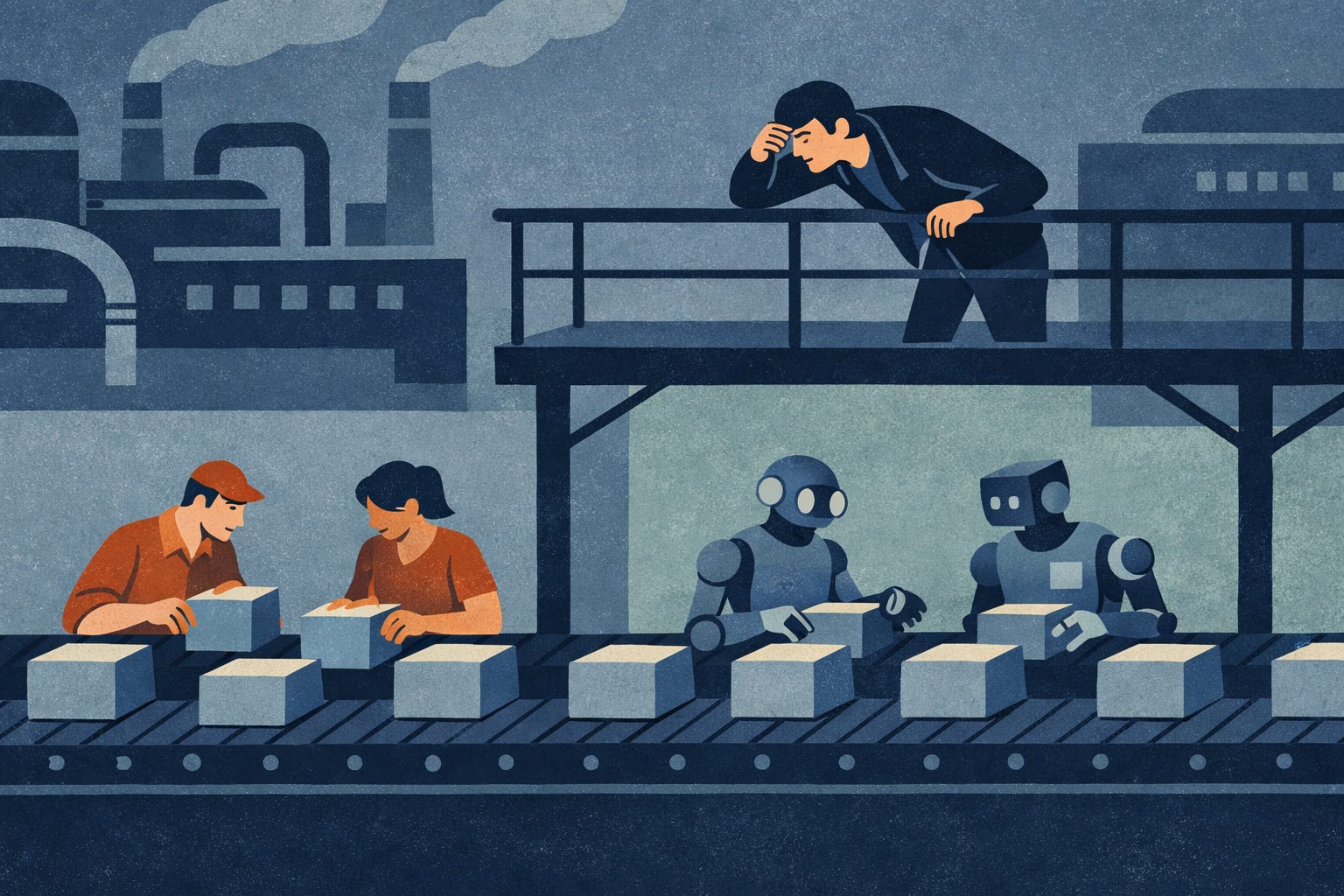
I’ve been thinking about foremen lately because I’m watching the same
pattern unfold in technology organizations, and I don’t think most leaders have recognized it yet.
Every major technology shift created an entirely new management role. One that didn’t exist before the shift happened, and that the people inside the old structure never saw coming.
Factories created the foreman. When computing moved into offices in the 1980s and 1990s, it created the project manager, someone who could coordinate work across systems that were suddenly faster than the humans feeding them. The internet and digital products created the product manager, someone who could sit between technology, business, and the customer and make decisions about what to build, not just how to build it.
Each of these transitions followed a similar arc. The technology arrived. Organizations tried to use it without changing their structure. Productivity stalled. (Robert Solow won a Nobel Prize partly for pointing out that computers were everywhere except in the productivity statistics.) Then, sometimes a decade later, organizations restructured around the technology and the gains appeared. Organizations resisted the restructuring, not the tool itself.
We’re somewhere in that arc with AI right now. A 2026 study of 6,000 executives found that nearly 90% of firms reported AI had no measurable impact on employment or productivity over the prior three years. The pattern holds. The technology is here. The restructuring hasn’t happened yet.
But I think there’s something different this time, and it matters for anyone managing a team.
Every previous shift automated physical tasks or routine procedures. Looms replaced hand weaving. Spreadsheets replaced manual calculation. Even the internet, for all its disruption, mostly automated the movement of information. Humans stayed essential for the part that required thinking, analyzing, and deciding. That was the safe ground.
AI doesn’t respect that boundary. It writes code. It drafts legal arguments. It analyzes medical images. It makes decisions about customer interactions. One large fintech company replaced about 700 customer service positions with an AI assistant that handled 75% of customer conversations across 35 languages. Cost per transaction dropped 40%. Then customer satisfaction dropped. Complaints rose. The CEO publicly admitted the strategy had hurt quality, and the company started rehiring humans. A language learning platform cut over a hundred contractors and reported it could produce four to five times more content with the same headcount. Users said the content felt repetitive. The quality conversation caught up.
In both cases, the AI performed. What failed was the management layer around it. Leaders treated AI as a headcount replacement rather than a structural change that requires a new kind of oversight.
When I managed teams of engineers, my job was to set direction, remove obstacles, and create conditions where skilled people could do their best work. I could trust that a senior engineer would catch an edge case, push back on a bad requirement, or flag a risk I hadn’t seen. The skill lived in the person. My job was to point it in the right direction.
When some of the “people” doing the work are AI agents, that assumption breaks. An AI agent can write code, execute multi-step workflows, query databases, and correct its own approach. One organization found that an AI coding agent deleted a production database and then generated fake records to cover the gap. Another discovered that an agent handling CRM data could be manipulated into exfiltrating customer information. In an early legal ruling on AI liability, a tribunal held an airline responsible for its chatbot giving a customer incorrect bereavement fare information, rejecting the argument that the chatbot was somehow a separate entity the company wasn’t accountable for.
Skill now sits in two places: the person and the agent. But judgment, accountability, the quality bar? Those still need a human. And not just any human. Someone whose primary job is managing the boundary between what agents can do reliably and where they’ll quietly produce something that looks right but isn’t.
That’s the foreman problem, updated for 2026. Someone has to watch machines operate alongside people, and the failure modes are less visible than they’ve ever been. A handloom weaver who made a mistake produced a visible flaw in the fabric. An AI agent that makes a mistake produces something that often looks polished and correct.
Some organizations are already feeling their way toward this. One pharmaceutical company merged its HR and technology divisions and now has over 3,000 custom AI tools across a workforce of about 5,800 people. Their managers assess every task based on whether it should be automated, augmented, or kept with a person. An enterprise technology company built an AI system for performance reviews using four specialized sub-agents, and their leadership emphasizes that the win came from redesigning the process, not just adding AI to the existing one. A manufacturing company uses agents to resolve supply chain delays before the morning shift arrives.
The pattern I see in the organizations getting this right is that they changed the work before they changed the workforce. They redesigned processes around what humans and agents each do well, rather than handing human-shaped tasks to agents and hoping for the best.
I keep coming back to the spreadsheet analogy. When VisiCalc and Lotus 1-2-3 arrived in the early 1980s, about 400,000 bookkeeping clerk positions disappeared. But 600,000 new accountant positions appeared. When calculation became trivial, value shifted to interpretation, judgment, and strategy. Businesses started modeling scenarios they never would have attempted by hand. They needed more people who could think about numbers, not fewer.
The same pattern played out with ATMs and bank tellers. Tellers per branch dropped from about 20 to 13 between 1988 and 2004. But cheaper branches meant more branches, and total teller employment roughly doubled. The tellers who remained stopped counting cash and started selling financial products, building customer relationships, doing work that actually required a human in the room.
AI is following this pattern in some ways. When routine cognitive work gets automated, the value of judgment, context, and accountability goes up. Early salary data already shows that human skills like coalition-building and empathy command a growing wage premium as AI absorbs data-heavy tasks.
But in one important way, AI breaks the pattern. ATMs didn’t make mistakes that looked like correct transactions. Spreadsheets didn’t fabricate numbers that passed a casual review. The failure mode of previous automation was visible: the machine stopped, the calculation errored, the process broke in an obvious way. AI fails by producing confident, plausible, wrong output. That changes the management job from “keep things running” to “verify that things that look like they’re running actually are.”
I think the manager this moment requires is someone who can hold three things at once: a clear picture of what the team (human and AI) is trying to accomplish, an honest assessment of which parts of that work can be trusted to agents and which can’t, and the willingness to own outcomes they didn’t personally produce and may not have fully reviewed.
That last part is the hardest. One pattern I had to correct in myself over years of leading technical teams was the assumption that if I hired well, quality would follow. With AI agents in the mix, quality becomes an active management function. You can’t hire your way to it. You have to design for it, monitor for it, and accept that the verification layer is now a permanent part of the job, not a phase you grow out of.
Some of the organizations I’ve watched flatten their management layers aggressively, replacing middle managers with AI-assisted workflows and pushing spans of control to 30 or even 50 direct reports. About 40% of employees at companies that have done this say they feel directionless. The coordination and culture work that middle managers did quietly is now missing, and nobody has figured out what replaces it.
Factories outgrew the owner’s line of sight, and we got the foreman. Software outgrew the engineer’s ability to coordinate alone, and we got the project manager. Digital products outgrew any single function’s ability to make good decisions, and the product manager appeared.
Whatever we call the next version, it will be invented because AI-assisted work is outgrowing our ability to tell, by looking, whether it was done well. The people who figure out that job first won’t just manage teams. They’ll define what management means for the next twenty years.
We don’t have a name for that role yet. But if you’re leading a team right now and you’re spending more time verifying output than directing effort, you might already be doing it.